Donnerstag, 6. Oktober 2011

Creme Brulee and German Potato pancakes

With this post I want to finish the French desserts and begin with German cuisine, that's also the reason, why this blog has such an unusually name. So, let's start with a very famous French dessert: creme brulee.

The history of this dish is partly in the dark. It is not sure, how actually invented this dessert, but the Trinity College in Cambridge claimed, to be the originator (more about history). But what actually is creme brulee? Creme brulee is French for burned cream and describes pretty good the dish. the definition is a custard with a sugar crust/glaze.
 I did such a creme brulee (recipe) and it tastes pretty good, but you want to make sure to use ceramic bowls, otherwise the heat wont spread out constantly over the surface and you’re result will look like the ones I did in a muffin form. Furthermore you want to make sure, when you mix the hot cream with the eggs, that you do that carefully and add only little amounts of the hot cream to the eggs under constant whisking to avoid scrambled eggs. This procedure is called tempering and very important for a good result of this recipe.


 my creme brulee in a muffin form


So, let’s start with the German cuisine, famous for their meat, sausages, cabbage and potatoes. My first recipe is a variation from the German “Kartoffelpuffer” (potato pancake), shallow fried cakes of grated potatoes, that are usually mixed with eggs and grated onions, and in my opinion an improvement. The original “Kartoffelpuffer” comes probably from Poland, where they are part of the favorite dish placki wegierskie (potatoe pancake and gulash). However in Germany they are typically served with mashed apples. Very often they are served during the “Oktoberfest”, a big festival, initial celebrated of the marriage of Ludwig of Bayern and princess Therese of Sachsen-Hildburghausen (more), together with other typical German and especially Bavarian food, e.g sausage salad, Radisalat, meat loaf, Allgäu cheese spaetzle, dumpling and apple strudel. 
But back to our recipe. If you do everything right you should get some flat brown cakes with a crust, which look like them in the picture.


sources:
http://allrecipes.com/recipe/german-potato-pancakes/detail.aspx 

Sonntag, 2. Oktober 2011

French Cuisine and Desserts


This chapter is totally dedicated to the French cuisine. Even if I am going to focus more on desserts I am starting briefly describing French cuisine. French food and beverages stand worldwide as delicacies. Most of the recipes France is famous for today, were developed during the Absolutism (more about history). But what makes French cuisine so special? Well, the answer is their sauces. None of the other European countries has developed that much different sauce.  Following is a little list with the most important ones plus a little description:
·         hollandaise Sauce (recipe) is an egg based sauce, mostly with butter, lemon and cayenne pepper.
·         roux sauce (recipe) is a mixture of fat and flour (1:1), which exists in tree different variants: light, medium, dark.
·         bechamel sauce (recipe) is white and creamy sauce made out of butter, flour, milk and salt and is one of the basic sauces from which many others could be produced.
·         demi-glaze sauce (recipe) is a brown sauce made out of Espagnole and a beef or veal stock.
·         vinaigrette sauce (recipe) is basically an oil and vinegar dressing.


Before I start with the French dessert, I want shortly write about the probably most famous French food next to French wine, cheese and baguette. I want to explain how to make a perfect croissant. Actually it’s easier than I thought, so don’t panic if you try cook some. The only two disadvantages of this dish are, you need a long time to make it and it’s not that healthy. You only have to keep in mind three tricks (recipe):
1.      If you have the dough ball roll it out to a cross with a thicker middle.
2.      Make sure that your butter is soft, so that you can easily form it.
3.      Give all the butter in the middle of the cross and fold the ends over the middle. Stretch the dough a little bit, if needed. Make sure that there are no holes, where you can see the butter.
4.      After that you have to let the dough rest for aprox. 2h, before you fold it the same way again except that you don’t add again butter.
5.      A god croissant has got over 1500 layers and with each folding you take the amount of layers by the power of three. That means you should fold it 5-6 times (but you can also eat it after the second fold)
6.      When you done with the folding roll the dough into a rectangle and cut out triangle. Then you just take the shortest side and roll it to a croissant.


this was my result. Your croissants should be bigger then my, to not burn that quick as my one in the middle.


So lets start with the desserts. One very famous French one is the Tarte Tatin (an upside-down French apple tart) originated by the by the elder of  two unmarried sisters who took over the running of their deceased father's hotel in the rural town of Lamotte-Beuvron (more about tarte tartin, more about tarts ). I didn’t make a Tarte tatin, but therefore I did a easy and very tasty one:

The only two thing you have to be careful with by making this tart, are firtstly that you use rubbed dough method, which basically means that you want some butter crumbs in your dough. And secondly that you have to be pretty careful, when you let your pastry cream become thicker, because you don’t want it burn on the ground and too thick. Everything else is actually very easy and god described in the recipe.
 By the way, talking about dessert pestry, one French one is Choux paste. if you like to try something diffrent with it click here.

Montag, 19. September 2011

Shepherd’s Pie and buttermilk biscuits

 Shepherd’s Pie (recipe)

The History of the shepherd's Pie is not that long than the History of other traditional English food, e.g.the one of the scones. It's history began in the 18 th century when the way of thinking of potatos as just animal food changes. Then the originally "Cotton pie" became famous to process remains.
The meat, traditionally used is sheep meat, which was very comman at the British islands.

The recipe on it's own is acctualy very easy. You just have to mix mashpotetos with cheese and milk, which will create the top part of your pie and sear the meat and vegetables.


Buttermilk Biscuit (recipe)
(source picture)
These Buttermilk Biscuit are as the Shepherd’s Pie an easy and traditionally recepie, but you have to care for two things to get a perfect buiscuit. At first you have cut-in the butter, what basicly means you want some little butter chunks in your dough. These are importent for a better taste. Second thing, you have to use a leavening agent  (a substance used in doughs and batters that causes them to rise) to make sure yourbiscuit grew in the ofen and becomeslight and airy.


Sources:
http://www.information-britain.co.uk/recipedetail.php?id=1
http://gfcelebration.com/2010/03/25/gluten-free-shepherds-pie-and-some-interesting-history/
http://www.marthastewart.com/319350/cheddar-topped-shepherds-pie
http://www.mouthofwonder.com/2006/09/buttermilk-biscuits.htm

Sonntag, 11. September 2011

British Island cusine

The British Islands or the states of Ireland, Northern Ireland, Wales, Scotland and England famous for their west-side-sea-climate, with it's mild temperature and a lot of rainfall. These climate conditouns and the location of the map are the reasons for the traditional food of the Britains, which is made out of grain, fish and sheep.  Out of these and more ingredients, the Britains have developed over the years a special cuisine.Two examples of theses cuisine are the Scoenes and the bread pudding. To learn more about their individualy history click here fore the scones and here for the bread pudding.


Simple Scones

Ingredients:
2 cups all-purpose flour
1/3 cup sugar
1 teaspoon backing powder
1/4 teasponn baking soda
1/2 teasponn salt
8 tablespoons unsalted butter (frozen)
1/2 cup chocolate chips
1/2 cup sour cream
1 large egg


Directions:
  • preheat oven to 400 degrees and adjust oven rack to lower-middle
  • mix flour, sugar, baking powder, baking soda and salt
  • grate butter into mixture and mix with your hands until mixture resemble coarse meal, then add chocolate chips
  • in a separate bowl whisk sour cream and egg until smooth
  • stir with fork cream mixture into flour mixture
  • then form a dough-ball with your hands
  • form the dough to a rectangle on a floured surface and cut it into 8 triangles
  • place on a cooking sheet and bake until golden (about 15-17 min)


Bread Pudding

Ingredients:
6 slices day-old bread (ideally sweet)
2 tabelspoon butter, melted
1/2 cup raisins (optional)
4 eggs, beaten
2 cups milk
3/4 cup white sugar
1 teaspoon ground cinnamon
1 teaspoon vanilla extract


Directions:

  • preheat oven to 350 degrees
  • breake bread into small peceasinto an 8 inch square baking pan
  • drizzle melted butter over it (optional: sprinkle with raisins)
  • combine eggs, milk sugar, cinnamon and vanilla and beat until well mixed
  • pour mixture over bread and pusk bread slidly downm until it is couverd and begins to obsorbe
  • bake for 45 min or until the top springs back when lightly tapped


Sources:
www.allrecipes.com

Mittwoch, 7. September 2011

Latin American cooking

Empanadas

 
Empanadas (Spain empanar: wrap in bread) are originate at Spain. they were just to make it easyer for workers to transport their lunch (mostly fish or meat) and give them a garnish.

Recipe:
Ingredients
  • 1/2 cup butter, softened
  • 1 (3 ounce) package cream cheese
  • 1 cup sifted all-purpose flour
  • 1 cup fruit preserves
  • 1/3 cup white sugar
  • 1 teaspoon ground cinnamon
Directions
  1. DAY BEFORE: Cream butter and cream cheese together until smoothly blended. Beat in the flour. Shape dough into a smooth ball, wrap in foil or cling wrap, and refrigerate overnight or up to a week.
  2. AT BAKING TIME: Remove dough from refrigerator 30 minutes before using. Start heating oven to 375 degrees F (190 degrees C).
  3. Roll chilled dough thin. Cut with 3 or 4 inch round cookie cutter. Place small spoonful of jam in center of each round, moisten edges with water.
  4. Fold round over and press edges together. Bake on ungreased cookie sheet 15 to 20 minutes. Immediately roll in sugar mixed with cinnamon (traditional) OR in confectioners' sugar if preferred.

The result of the recepie, wih you can see in the picture above, is a smal dough bag with the respective filling. I can only recommand that recepie, and I thinks waht for everybody, because they are easy to make and the filling can be varies.


Salsa


Salsa, it appears in a lot of diffrent variants, e.g. Salsa Verde, Salsa Mexicana, Salsa Brava (more salsa recipes). But what acctually are the features of a salsa?
A Salsa is a a spicy sauce of chopped, usually uncooked vegetables or fruit, especially tomatoes, onions, and chili peppers, used as a condiment. (quote)
As many other Latain American recipes the history of salsa starts with the native peoples of South America. The reason for  that salsa was originated there and not somewhere else was an importent ingreadiant which only grow, at this time, at America. This ingreadiant was a little pepper called Jalapeño.
And still today, the most Jalapeño come from Mexico ( especially Veracruz and Oaxaca) and the US.

Recipe:

Ingredients
  • 3 Roma tomatoes, chopped
  • 2 garlic cloves, minced
  • 1 seeded and minced jalapenos, plus 2 roasted, skinned and chopped jalapenos
  • ½  red bell pepper, fine dice
  • ¼  red onion, fine chopped
  • ½  tablespoon olive oil
  • ½  lime, juiced
  • Chili powder, salt, and pepper, to taste
  • Fresh scallions, cilantro or parsley, to taste
Directions
In a bowl, combine all ingredients. Place in refrigerator for up to 12 hours for flavor infusion.
Serve with tortilla chips.

The salsa of this recipe, has maybe not the consestence like the ones you by at the supermarket, but especially when all the ingreadiants are frehs you should try this salsa, where you can easy chanche the sharpness until you  like it most.


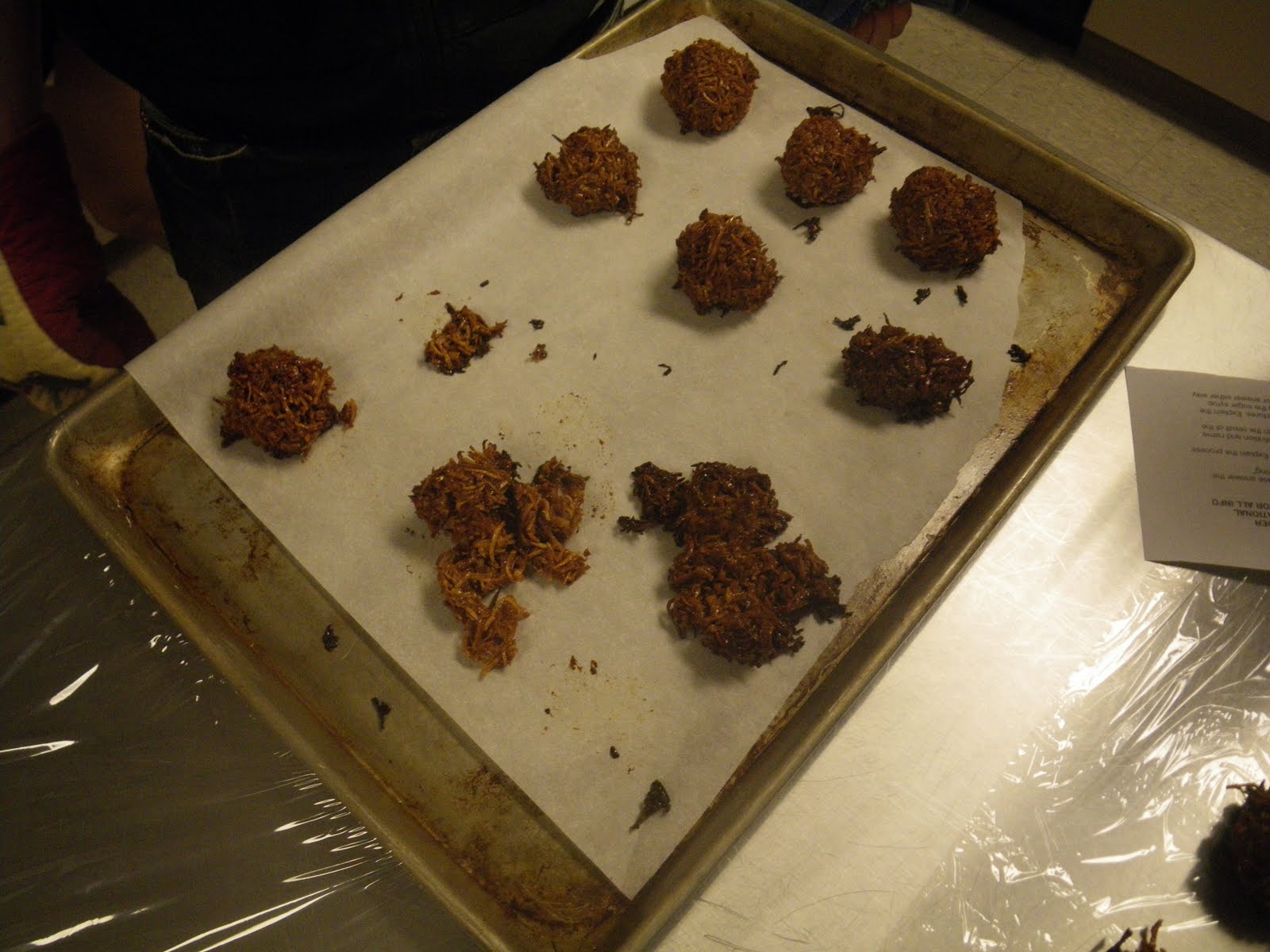
Brasileira cookies


recipe:
ingredients for approx. 10 cookies:
1cup granulated sugar
1/2 cup water
4 egg yolks
1/4 cup all purpose flour
2 and 1/4 cup granulated coconut
1/2 teaspoon vanilla
Directions:
  • heat up sugar and water together until 230°F (when no thermometer: little bit of sirup given into ice water should immediately form a hard thread)
  • Combine yolks and flour
  • add two tabelspoon of sugar water to the mixture
  • add hole mixture to remaining sugar water
  • add coconut over low heat and string constantly until it becomes thick (tip your sugar should caramelize)
  • add vanilla and cool to room temperature
  • form little balls and leave 1 inch space between each at the baking sheet
  • bake in a preaheatet oven at 375°F for 15 min until they become golden brown
  •  
The result of the cookies can you see in the lowest picture. It's more or less a caramel-coconut-ball and tastes very good, but you really have to like coconut, otherwise this are the wrong cookies for you.


Sources:
http://www.elamanecer.ca/culinaryhistoryempanadas.htm
http://www.roomserviceusa.com/articles/History_Of_Salsa_Sauce_The_Mexican_Connection.php
http://www.thefreedictionary.com/salsa
http://www.chefkoch.de/rs/s0/salsa+saucen/Rezepte.html